|
|
||||||
|
|
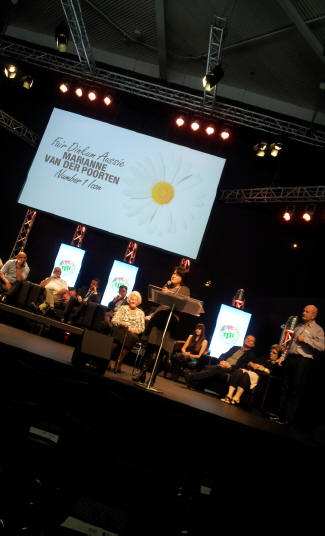
The 1st Icon Marianne Van Der Poorten Bob the Boss's thoughts on Marianne Van Der Poorten ”Marianne is an absolute inspiration for me. She is so alert and switched on it is amazing. I find her to be 99 years young. Everyone in management loves it when the Van Der Poorten tribe arrive. Mind you I have to get Marianne settled on the lounge before The Bold & The Beautiful commences. One story that comes to mind is that Marianne was staying in unit 50 and I wanted to introduce her to some friends in unit 52. Not a problem but I had to wait until she put on her lipstick. “Do you think they will have white wine or should we take ours?” she says. My friends loved her!! Personally I salute the bravery and character of Marianne. Aussie Bob Saying for Marianne is ”When life gives you a reason to cry… quickly find 2 reasons to smile”. I am very proud to have Marianne as our first Aussie Icon”. Bob the Boss.  Marianne Van Der Poorten was born in Amsterdam, Holland inl9l4 to Rudolf and Matilda Stokvis. Her elder brother, Bernard, was born in 1912. Their father was a diamond merchant and she remembers a happy childhood although Rudolf was called up for Army service for extended periods during World War I. Marianne had learnt English at school and from the age of 15 years to 26 years she worked at the Western Union company where her English became proficient. She loved rowing and belonged to the local rowing club. It was there that she met her husband to be, Dr David Van Der Poorten. They married on 1st April 1939. Malieke was born in 1940 and Alfred was born in1942. When the Nazis invaded the Netherlands in May 1940 the young family tried to escape to England. The attempt failed. They then became involved in the Dutch resistance movement, by Falsifying medical reports to help possible victims and by providing shelter in their own home at great risk to themselves They had to give up their children into the safe custody of good friends and went into hiding. After 18 months they were betrayed by their neighbours and, with Marianne’s parents were deported to the Dutch transit camp Westerbork. Detained in the punishment barrack for two months, they succeeded in obtaining false baptism papers through their contacts with the resistance. The forged documents arrived too late to prevent Marianne’s parents being deported to Auschwitz where they perished in the gas chambers’ David and Marianne were then sent to the Theresienstadt concentration camp where Marianne worked all day in a factory and then helped look after children in the children’s barracks at night. After liberation Marianne nursed her husband along with 60 other inmates all of whom were sick with typhus. Once David had recuperated they returned to Holland also bringing back 2 surviving orphaned children with them. They then went on to re-establish their lives’ Marianne and David received a special honour; three daisies of enamel on gold fashioned into lapel pins which were presented to a number of people in recognition of their outstanding efforts to save the lives of those pursued by the Nazis in Holland for religious, political or other reasons during the period 1940 to 1945. Queen Juliana had chosen the daisy as a symbol of freedom when the Dutch royal family went into exile in Canada during the war. The Dutch resistance movement then adopted the daisy as its own emblem. In 1947 Rose was born. In 1951 the family emigrated to Australia. In the early years David had to re-study medicine so that he could practice in Australia. During this time Marianne housed borders as well as looked after the family’ Once settled in Australia and once re-qualified David established a medical practice in King’s cross, Sydney. Marianne then joined the Netherlands society and became an honorary social worker helping needy Dutch immigrants, including making hospital visits and assisting many of the thousands of Dutch people who came to Australia in the 1950s to integrate into the Australian pattern of life. She helped Dutch women learn English and helped the Australian wives of Dutch men to learn the Dutch language and customs. From 1956 to 1982 she served on the social committee of UNAA which raised money for UNICEF, at first as the Netherlands Society representative and later as the WIZO representative’ Marianne had first joined WIZO (women’s international Zionist organisation) whilst living in Amsterdam. This is the largest social welfare organisation in Israel. She only came to understand the full significance of the Zionist movement while in concentration camp. She knew that the Dutch people who survived the war could go back to Holland and pick up the threads of their former lives, but what of the Poles, Russians, Germans and others classified as displaced persons who would have nowhere to go. The necessity for a homeland for Jewish persons was forcibly impressed upon her once she settled in Sydney. She rejoined WIZO and for over 50 years held leadership positions at group and executive level. Since 1949, after the establishment of the State of Israel, she has celebrated her birthday each year by requesting donations for WIZO instead of personal birthday gifts. Over the years Marianne has supported many other Australian organisations, especially those Orientated to assisting children. David’s and Marianne’s home was always open to everyone; their Dutch friends who replaced the extended family which they had lost during the war, and their many new Australian friends, all of whom were made welcome to visit at any time. Their large extended dining room table often hosted 26 people on special occasions and on regular weekly family dinners. Marianne has experienced many challenges during her life. These included the deaths of her parents and many family members who perished during the war. There followed the tragic death of her daughter Malieke in 1967, the unexpected death of her husband David in 1969 and more latterly the death of her son Alfred in 2010. During these times Marianne displayed strength, courage, determination and a positive outlook on life. These characteristics have helped her deal with the loss of many close friends and family members over the years and have provided, and continued to provide an inspiration to her family, her friends and everyone who has come to know her, whether young or old. Marianne at nearly 99 years young still drives, is a competent bridge player, reads the newspaper daily from cover to cover, enjoys eating out, drinks a good glass of wine, attends meetings, loves going to the movies and above all loves going away with her family. When confronted with personal challenges, Marianne’s personal philosophy is to refrain from complaining and to try to focus on those whose situation is worse than hers. Above all, she is convinced that it is a mistake to concentrate too much on the past She endeavours to live each day to the full. In embracing this approach she feels blessed at having escaped the gas chambers and to be able to enjoy the company of her daughter, daughter-in-law, son-in-law, 5 grandchildren and 11 great-grandchildren. About seven years ago Marianne had the pleasure of meeting Bob and his family when she decided to take her daughter, grandchildren and great-grandchildren to the Star of the Sea complex in Terrigal. Since then she and her extended family have stayed in the complex on 14 occasions and it has become a family tradition to spend holidays each year there. During this time she has come to know the excellent manager Bob very well and is excited and humbled to have been asked by him to be part of his “Fair Dinkum Aussie” incredible philanthropic venture.  |
||||||
|
|
|||||||
|
|||||||